



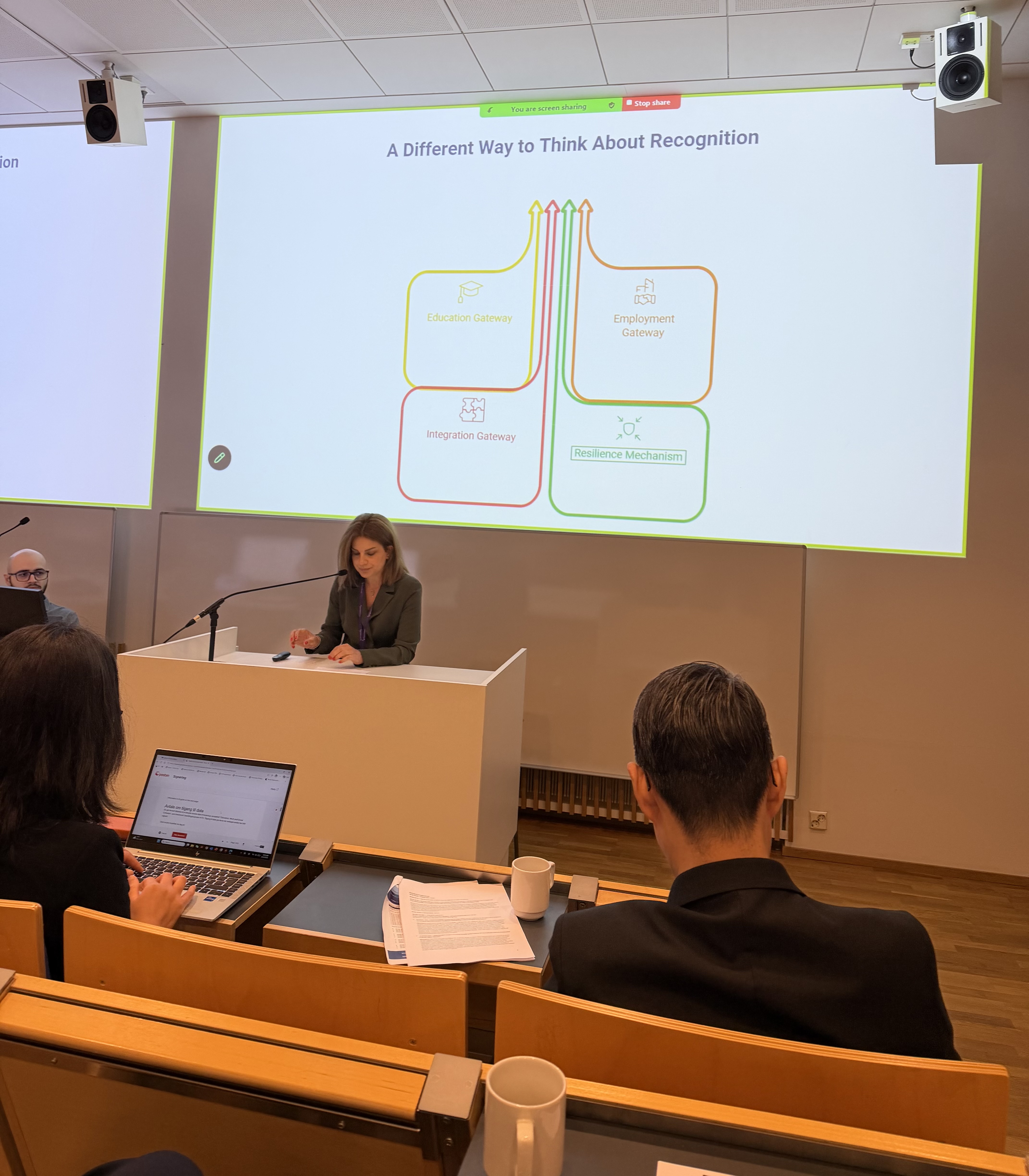
On August 13–14, 2026, ArmENIC participated in the Nordic-East Asia Higher Education Research Symposium 2026, held at Tampere University, Finland under the theme “Turbulent times in Higher Education and Society.”
The symposium brought together researchers, higher education experts and practitioners from different countries to discuss the challenges facing higher education in an increasingly uncertain and rapidly changing global environment. Discussions addressed higher education resilience, internationalisation and mobility, geopolitical uncertainty, quality assurance, digital transformation, artificial intelligence, equity and inclusion, and the changing role of higher education in times of crisis.
Representing ArmENIC, Gayane Harutyunyan, Director of ArmENIC, and Ani Hovhannisyan, International Relations and Strategic Development Coordinator, contributed to the academic programme with a presentation entitled “Beyond Procedure: Qualification Recognition in Armenia’s Multi-Crisis Context.”
The presentation examined qualification recognition beyond its traditional administrative and procedural function, highlighting its role in higher education resilience, academic mobility and social inclusion in contexts affected by multiple and overlapping crises.
Drawing on Armenia’s experience, the presentation explored how qualification recognition systems and information centres can respond to rapidly changing circumstances while maintaining the principles of fairness, transparency, quality and trust. It addressed challenges arising from disrupted education pathways, displacement, incomplete documentation and changing patterns of international mobility, demonstrating how recognition practices can adapt to exceptional circumstances and support individuals in continuing their education and pursuing academic and professional opportunities.
ArmENIC’s participation in the symposium provided an opportunity to share Armenia’s experience with an international academic audience, exchange expertise on qualification recognition and higher education policy, and strengthen professional networks for future cooperation and research. Moreover, it reflects ArmENIC’s continued commitment to international cooperation, knowledge exchange and the development of evidence-based approaches to academic recognition and mobility.


